Here’s How to Train

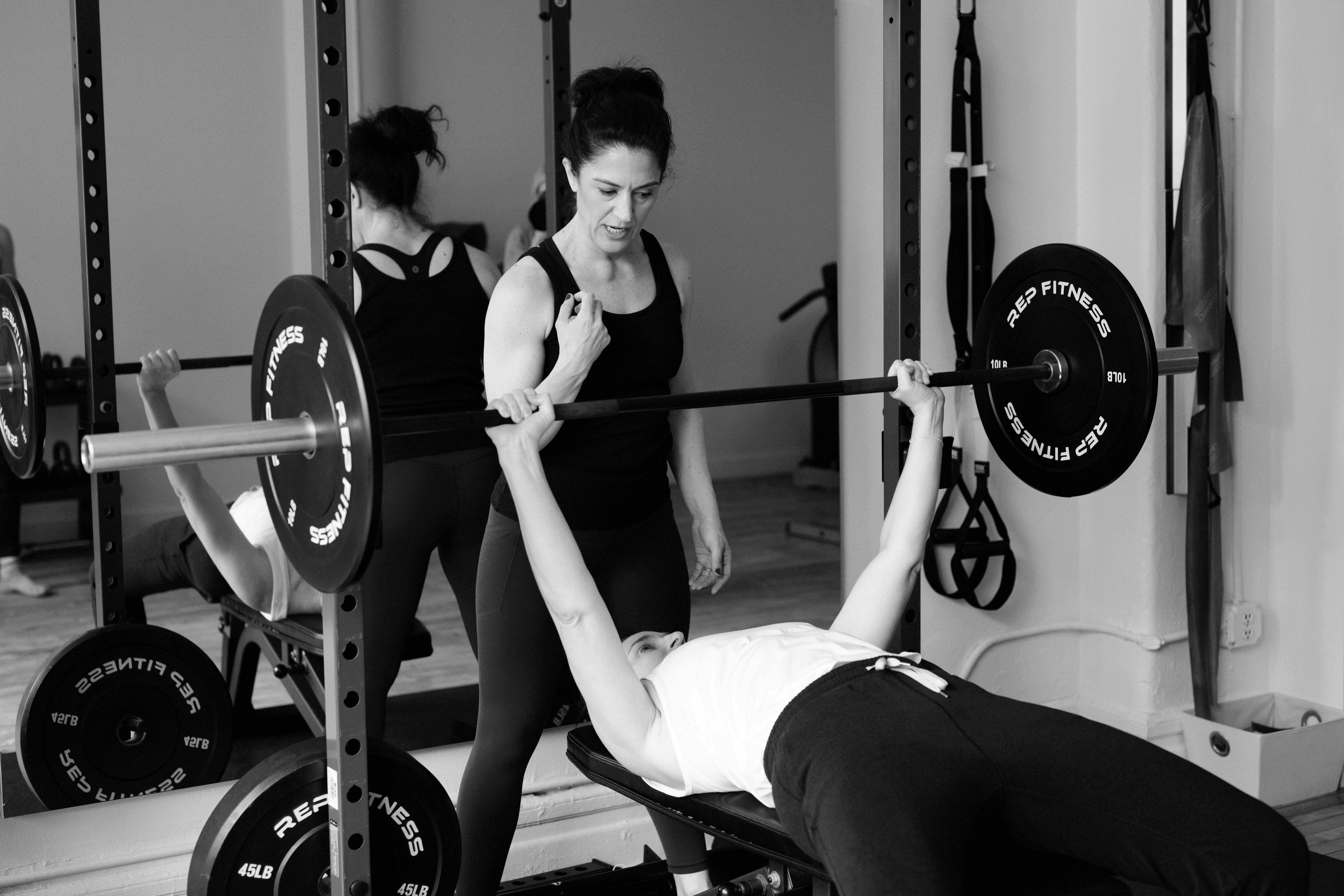
Since I started this Substack, I’ve had a lot to say: about strength training as life training, about limiting beliefs, about showing up average, about why being strong at 80 should be the most unremarkable thing in the world. But I haven’t actually shown you what strength training looks like—what I teach in my classes. I promised those details last week. Here they are.
The big hurrah? It doesn’t have to be complicated. The most effective training is often simple and repetitive. (Sorry if that sounds boring. Get yourself a cute outfit and a killer playlist if you need to spice things up.)
When onboarding new True Strength Academy students, I focus on six movements: the Squat, the Push, the Pull, the Deadlift, the Lunge, and the Farmer Carry. That’s it. Six multi-joint, functional movements that work the whole body, mirror what you already do in daily life, and can be scaled to meet you exactly where you are today and forever.
Still think these moves might be too much for you? Not a chance. Because you are already doing them. When you get up from a chair, you’re squatting. When you pick something up off the floor, you’re deadlifting. Carrying groceries home from Whole Foods? Farmer Carry. You already know more than you think.
These movements are also a framework. Once you understand a lunge, a lateral lunge or a split squat makes immediate sense. Once you understand the basics of pulling, you can get on the assisted pull-up machine and figure it out. Master these six moves and you can train anywhere, anytime, with whatever equipment is available.
Need a little help? Check out this tutorial I created for 4 of the 6 movements.
How much and how often?
Contrary to popular belief, you don’t need to kill yourself in the gym every day to see results. The exercise science is pretty clear: 2–3 days per week, 30–45 minutes per session, hitting major muscle groups each time is enough to increase strength, muscle mass, and bone density. Choose one or two exercises per muscle group and perform 8–12 reps per set, working to near failure — the last few reps should feel hard.
How do you know when to progress?
Here are a few signs that you’re making progress: smoother movement, faster recovery between sets and sessions, more reps before near-failure, heavier weights lifted. When you see these signs for a couple of weeks, it’s time to increase your effort by picking up a heavier weight, adding more sets or repetitions, or moving faster through a set.
What about all those cool moves I see people doing?
At some point you may want to add movement variety — to address specific goals or just keep things interesting and fun! But these six movements alone will get you there: stronger muscles, denser bones, real strength. Start here and stay here and you will get strong. Functionally, satisfyingly strong.
That’s it. The whole plan. Got it? Now go find a cute outfit, make a bangin’ playlist (or cue up a True Crime podcast) and get to the gym.
In strength, Elizabeth
If this essay made you want to actually do the thing — I have a class for you.
TSA: Practice Lab is an 8-week small-group program built around the exact movements I described above. We slow down, drill, and troubleshoot. You’ll leave with real technical understanding and the confidence to train on your own.
This is a good fit if you’re a TSA alum who wants to revisit the fundamentals, if you’re returning to training after time away, if you know some basics but want real coaching and eyes on you, or if you want to train with me but can’t commit to the 12-week Foundations class.
(This course is not a good fit if you're an absolute beginner, are dealing with an active injury, or need one-on-one attention.)
Wednesdays, April 15 – June 3 | 2:30–3:30pm | Practice Human, NYC | 3 Spots left
Early bird tuition is $650 through March 31 with code PRACTICELAB26. Regular tuition is $725.
Register HERE.